
While the government has the option of ensuring the passage of these Bills as money Bills, there are voices within the government advising discretion on the GST roll-out by April 1.

'I am very happy to see that the work is starting to bear some fruit now.'

The coaching-tuition-profiteering model built on the back of a broken education system is a scandal and an abomination, and must go, asserts Shekhar Gupta.

Kerala Finance Minister K N Balagopal has sought systemic changes in the GST structure, saying every state and consumer has lost because of its basically flawed architecture that has also led to rampant revenue leakage for the states. The Goods and Services Tax (GST) regime came into force in July 2017. Even though the framework is focused on having a one-nation-one-tax model, quite a few items, including petroleum products and liquor are still out of the GST purview.

The government introduced the 122nd Constitution amendment Bill.

Plug-in hybrids have two engines and the electric part has a much larger battery than in the regular hybrids. Car companies, led by the Japanese, are pushing the Indian government to look at hybrids in the interim if it wants to reduce carbon emission.

It appears that things will crystallise on several aspects of the GST only by end 2008. This means that the country will only have a period of 15 months, from beginning 2009 to March 2010, to ensure that all the constitutional policy and legislative changes take place. It does seem increasingly a big challenge, says S Madhavan.

It has hiked prices of diesel variants of Ciaz and Ertiga models with smart hybrid technology

From filing 37 returns a year when the Goods and Sales Tax was first introduced in July last year, the process has undergone major changes as the GST Council considered and implemented various models to ease the pain for assessees. Here's a recap of how the process has changed in 10 months.
A slew of challenges that are yet to be resolved include the lack of consensus between the Centre and states over the GST exemption threshold limit, dual control over scrutiny and assessment
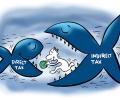
With the implementation of the goods and services tax less than 75 days away -- assuming July 1 as the roll-out date -- Sudipto Dey provides a guide to how businesses can navigate the transition.

The list of exempted goods from central excise duty has shrunk from 400 items in 2011-12 to 300 now.

The panel might also decide on a new chairman.
"At present, there are two main rate slabs under which sa majority of goods are covered -- five per cent and 12.5 per cent -- which will now increase to three (five per cent, 12 per cent and 18 per cent).Will this result in multiple litigations is anybody's guess."
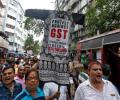
After 17 tumultuous years, a nationwide Goods and Services Tax (GST) will rollout from midnight of June 30, overhauling India's convoluted indirect taxation system and unifying the $2 trillion economy with 1.3 billion people into a single market.

India studied the Malaysian model, which was scrapped on Wednesday, before implementing the GST and borrowed the anti-profiteering clause to ensure GST benefits are passed on to the end-consumer by the industry

'Like every Budget, this time, too, there is chatter around tinkering with the long-term capital gains tax.' 'Investors may not want to jump into the markets until there is clarity on this front.'
One of the grey areas is whether the anti-profiteering provisions can provide for a comparison of tax rates between the pre-GST and post-GST eras, says Niraj Bagri.

'It is necessary to have a person at the top who can make strict decisions without hesitation. Modiji has done that.'
GST implementation could happen in September itself, with the next meeting of the Union Cabinet likely to take up the matter.

http://im.rediff.com/money/2023/jul/20uv.jpg

'The private sector believes that some enablers in labour-intensive sectors like apparel, toys, tourism, and media retail, can unlock a lot of jobs.'

When it comes to electric cars, the electric dream is turning out to be a six-letter word starting with f, ending with y, and having antas in between, notes Suveen Sinha.

Barely 10% of small businesses are in a GST-ready position, say experts

Experts share their views on the steps that will help businesses become GST-ready.

Singapore's single-rate GST structure cannot be India's model. But its practice of early announcement of rates much before their implementation should be emulated by India, says A K Bhattacharya.

'It's better to be over-insured than underinsured.' 'Ensure your home insurance includes STFI (storm, tempest, flooding, and inundation) cover for protection against monsoon rains.'

The new government may also introduce a separate scheme for revival of stranded gas-based power projects
'The professional or the freelancer needs to pay taxes from his pocket first and then wait for payments from his clients.'
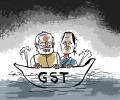
Retaining the GST rate assumes importance since states are under pressure to increase their revenues, hit hard by lockdown. Also, the Centre has not fully compensated states for their revenue losses on account of GST for 2019-20.
The states have unanimously pitched for sole administrative powers to carry out assessment, scrutiny and enforcement for entities up to an annual turnover of Rs 1.5 crore.
If the concerns over risking political capital are overcome, the long-term gains for the Indian economy will be immense, asserts A K Bhattacharya.

GST will yield 'better value for money' for car buyers, increasing automobile industry demand, says Sandip Neogi.

'Just today a shopkeeper I went to was saying how bad business is. He must have been a BJP supporter.' 'He finally said, "It's a good thing there's an NDA government, not a BJP government, 'they' had become too big for their boots,".'

The GoM will meet on Saturday to finalise single-stage, simplified, return filing under the GST; report will be placed before GST Council on March 10.

Lack of visibility on rates makes companies apprehensive.
Continued lack of consensus at next meeting could cast shadow on GST rollout by April 1.

A minimum levy of 12 per cent GST on tea will increase the cost, which will ultimately be passed on to consumers.
The changes made in the revised GST draft throw up fresh issues but, overall, most of these look sensible, says T N C Rajagopalan.
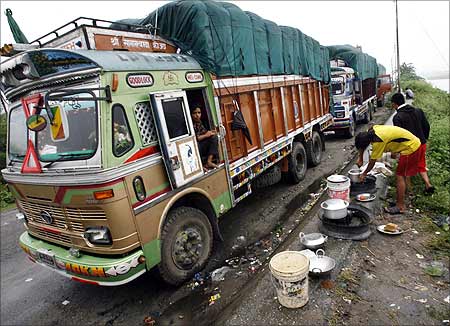
There could be a strong incentive for tax payers to avoid the higher tax burden.
 © 2026 Rediff.com - Advertise with us - Disclaimer - Privacy Policy - Sitemap - Feedback - About us - Terms of use - Grievances